
Available 24/7 in Mission Viejo
Water Heater Relief Valve Leaking or Dripping: What It Means
The pipe on the side of your water heater is dripping. That valve is a safety part, so here is what the leak means and what to do about it.
Call Now – (949) 693-0298In this guide
- Worn or dirty valve seat
- High house water pressure
- No expansion tank
- Temperature set too high
Why is my water heater relief valve leaking?
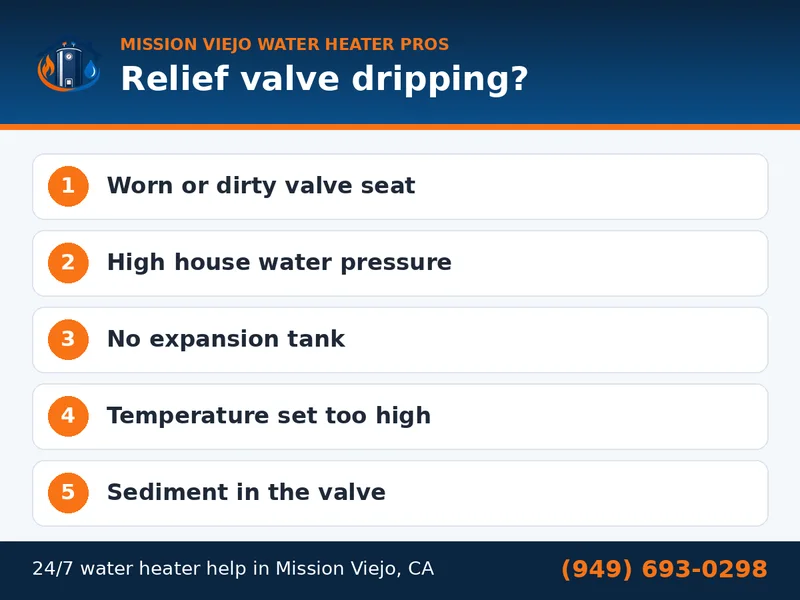
The temperature and pressure relief valve, or T&P valve, opens when the tank gets too hot or the pressure gets too high. A drip can mean the valve is worn or dirty, but it can also mean the pressure in your home is too high, the tank has no expansion tank, or the temperature is set too high. A new valve costs about $150 to $350. Call (949) 693-0298 if it keeps dripping.
Our leaking water heater repair service finds where the water is coming from and fixes the cause, not just the valve.
Is a dripping relief valve dangerous?
The valve itself is doing its job. The danger is in what it is warning about. If the tank overheats or builds too much pressure and the valve cannot open, the tank can fail. Never cap, plug or remove the discharge pipe. If the valve is gushing hot water or the tank is making loud banging sounds, turn off the gas or power and call right away.
The U.S. Department of Energy water heating guide covers safe temperature settings and basic upkeep.
What causes too much pressure in the tank?
When water heats, it expands. In homes with a pressure regulator or a check valve at the meter, that extra water has nowhere to go, so pressure spikes in the tank. An expansion tank on the cold line gives it room. High street pressure, or a failing pressure regulator, can also push the house above a safe level of about 80 psi.
- Check house pressure. A gauge on a hose bib reads it in seconds. Above 80 psi is too high.
- Look for an expansion tank. It is a small tank on the cold line above the heater. Many older Mission Viejo installs do not have one.
- Check the setting. Around 120°F is enough for most homes.
Can you fix a leaking relief valve yourself?
You can test it by lifting the lever briefly with a bucket under the pipe, which can flush out debris. If it keeps dripping after that, the valve needs to be replaced. Replacement means draining the tank partway and working on a pressurized safety part, so most owners leave it to a pro.
If the drip is coming from the bottom of the tank instead, see our guide to a water heater leaking from the bottom.
When should you replace the water heater instead?
If the relief valve leaks and the tank is also rusty, leaking at the base, or more than about 10 to 12 years old, replacing the heater is often the better choice. A new 40 to 50 gallon tank costs about $1,900 to $3,800 installed, and we add an expansion tank and set the pressure right as part of the job.
Our water heater replacement mission viejo page explains what is included.
What should you do right now?
Put a bucket under the discharge pipe, lower the temperature setting a little, and note how often the valve drips. If it drips only after long showers, thermal expansion is the likely cause. If it drips all the time, the valve or the house pressure needs attention.
Need help today? Our water heater repair Mission Viejo techs are on call 24/7.
Frequently asked questions
Is it normal for a water heater relief valve to drip?
A rare drip can happen, but a steady drip points to a worn valve, high pressure or a missing expansion tank.
How much does it cost to replace a T&P valve in Mission Viejo?
About $150 to $350.
Do I need an expansion tank on my water heater?
Most homes with a pressure regulator or a check valve need one. It gives heated water room to expand so pressure does not spike.
Can I plug the relief valve pipe?
No. Never cap or plug a relief valve or its discharge pipe. It protects the tank from bursting.
Talk to a water heater pro now
Questions about your water heater? Call a local pro in Mission Viejo, CA. Open 24 hours a day, 7 days a week.
(949) 693-0298 Call Now – (949) 693-0298